Terrazzo Floor Guide: How to Choose the Right One

Choosing a terrazzo floor for a commercial project involves more than picking a color from a sample book. The right material needs to match the design, traffic level, installation method, project size, and maintenance requirements.
As a manufacturer, we often see the same situation. A terrazzo sample may look perfect, but project teams still need to consider slab size, thickness, aggregates, surface finish, and installation.
At Dongxing Group, we produce inorganic terrazzo slabs and tiles for commercial interiors. Based on our production experience, here are the main points we recommend checking before making a decision.
Start With the Project Requirements
Before looking at colors, first understand where the material will be used.
Terrazzo works in many settings, including hotel lobbies, shopping areas, office entrances, restaurants, and residential interiors. However, each application has different requirements.
For high-traffic areas, the material needs to work well with the expected level of daily use. For a feature area, appearance and design may be more important. Large commercial projects also need stable supply and consistent production.
This is why we recommend deciding the application first and the appearance second.
Project teams should also consider the substrate and installation method at an early stage. The thickness of the terrazzo, panel or tile size, fixing method, and site conditions all affect the final result.
What Makes a High-Quality Terrazzo Material?
Manufacturers combine a binder with stone aggregates to produce terrazzo. The aggregates can include marble, granite, quartz, or other natural stone fragments.
This is where terrazzo stone becomes important.
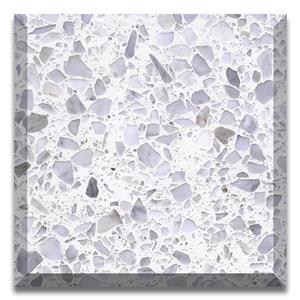
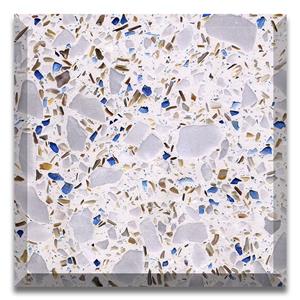
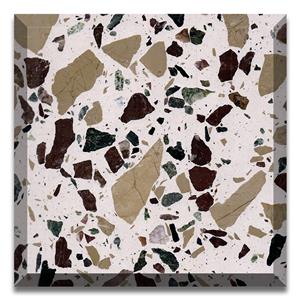
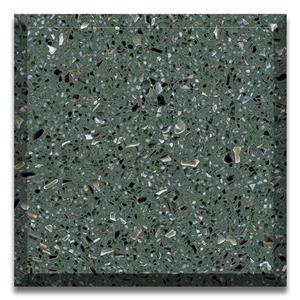
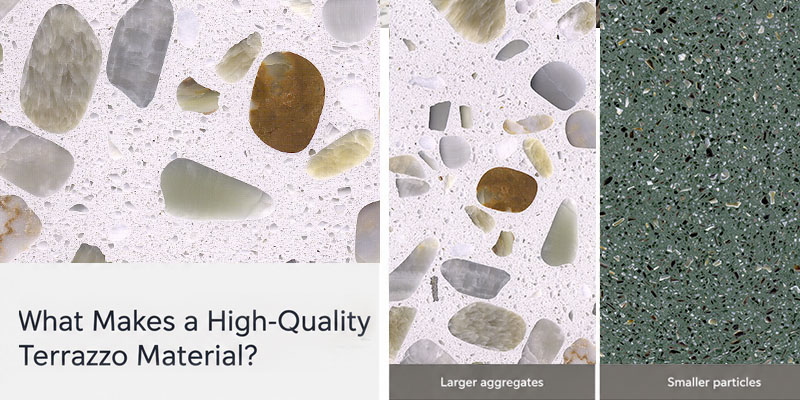
The aggregate is not simply a filler. It has a major effect on the final appearance. Large aggregates create a stronger visual pattern, while smaller particles can give the surface a more uniform look.
The base color also changes how the aggregates appear. A light base can make dark particles stand out, while a grey or beige base can create a softer overall effect.
For this reason, we recommend evaluating the entire terrazzo surface. Do not judge the material by its base color alone.
Choosing the Right Terrazzo Design
A good terrazzo design should work with the rest of the interior rather than compete with it.
For modern commercial spaces, designers often choose neutral bases such as white, grey, beige, or soft pink. Designers can use different aggregate colors to create contrast or connect the floor with walls, furniture, and other materials.
The size of the aggregates is another design decision.
Large marble chips create a bold and distinctive terrazzo pattern. Fine aggregates create a more subtle look, which often works well across large areas.
At the factory, we also control how we distribute the aggregates throughout the material. One area of a sample may look especially attractive. However, a large project needs consistent visual balance across many pieces.
Terrazzo Slab or Terrazzo Tile?
The project size and installation plan can help determine whether to use a terrazzo slab or tiles.
Large slabs can create a cleaner visual effect because there are fewer joints. Designers often choose large slabs for walls and floors when they want the terrazzo pattern to flow across a wider surface.
Tiles are easier to handle and offer greater flexibility during installation. They work particularly well in smaller areas or modular layouts.
At Dongxing, we produce different sizes according to project requirements. We can recommend standard or custom sizes based on the application, transportation, installation method, and required quantity.
There is no universal “best” size. The right choice depends on the project.
Why Precast Terrazzo Is Worth Considering
For commercial projects, precast terrazzo provides an important advantage: the material is manufactured before it reaches the construction site.
Manufacturers can control the production process in a factory environment. This includes raw material selection, mixing, molding, curing, grinding, polishing, and quality inspection.
This allows the manufacturer to control the material more consistently than producing the finished surface directly on site.
For project teams, this can make scheduling and quality control easier.
Dongxing produces inorganic precast terrazzo using a cement-based binder and natural stone aggregates. We use high-frequency vibration and vacuum high-pressure molding during production. These processes improve material density and help reduce internal voids.
Thickness Is Not the Only Factor
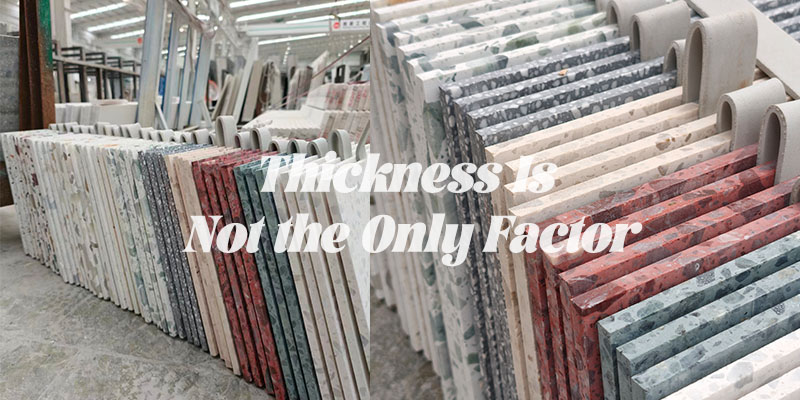
When choosing a commercial terrazzo floor, it is easy to focus only on thickness.
In practice, thickness is only one part of the decision.
The substrate, structural conditions, expected loads, panel or tile dimensions, installation method, and manufacturing quality all affect how the finished material performs.
For example, our 10mm terrazzo slab weighs approximately 25.5 kg/m². A thinner slab can reduce material weight. However, its suitability depends on the application and installation system.
This is why we recommend confirming the complete installation system before selecting a thickness based only on a sample.
Surface Finish Also Matters
The surface finish changes both the appearance and the way the material feels.
Polished terrazzo provides a smoother and brighter appearance and can highlight the stone aggregates.
Designers often choose honed terrazzo for its softer, less reflective appearance when they want a more understated surface.
Other finishes may also be available depending on the product and application.
For commercial flooring, consider more than appearance. Also evaluate expected use, cleaning requirements, and the slip performance of the finished surface.F
What About Color Consistency?
For a large project, color consistency is one of the most important points to discuss with the manufacturer.
Natural stone aggregates themselves have variation. At the same time, differences in mixing, curing, grinding, and polishing can affect the finished appearance.
This is why factory quality control matters.
At Dongxing Group, we check materials throughout production rather than only inspecting the finished product. Raw materials, aggregate distribution, molding, curing, surface treatment, and final inspection all have an effect on the finished terrazzo.
For large orders, it is also important to approve a production sample before full production begins.
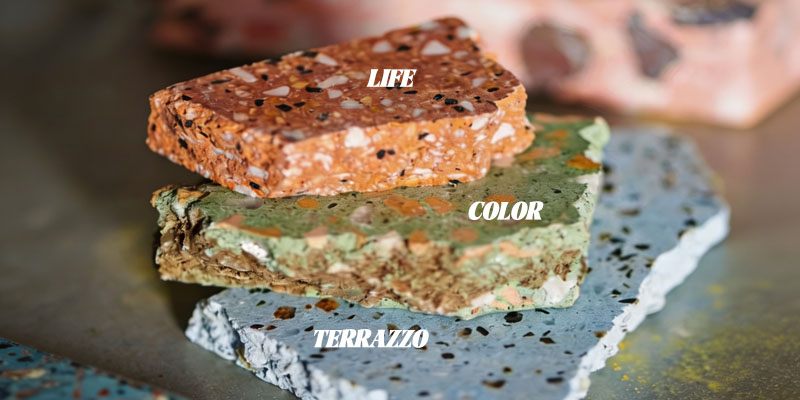
How to Choose the Right Material
Before placing an order, we recommend checking these five things:
Application: Where will the terrazzo be installed?
Design: What base color, aggregate size, and pattern do you need?
Size: Are slabs or tiles more suitable for the installation?
Performance: What thickness, surface finish, and technical specifications does the project require?
Supply: Can the manufacturer provide enough material with consistent quality?
These questions can prevent many problems later in the project.
Dongxing Group's Approach to Terrazzo
At Dongxing Group, terrazzo is one of our main stone products. We work with natural stone aggregates and inorganic cement-based materials to produce precast terrazzo slabs and tiles.
For us, producing terrazzo is not only about creating attractive colors. Our production process needs to deliver a stable material that we can manufacture consistently for commercial projects.
For this reason, we encourage architects, designers, contractors, and buyers to discuss the intended application with the manufacturer before selecting a product.
A good terrazzo floor starts with a good design, but the final result depends on much more than design alone.
Final Thoughts
The best commercial terrazzo is not necessarily the most expensive option or the most eye-catching sample.
It should be a material that fits the project from design to installation.
Look at the aggregate, base color, size, thickness, finish, production consistency, and installation conditions together. When project teams evaluate these factors early, they can choose a terrazzo material with reliable long-term performance.